
Architecting Autonomous AI Agents: Native Tool Use & Multi-Agent Guardrails
A blueprint for building resilient agentic systems with deterministic state recovery, safe tool execution, and multi-tier subagent routing.

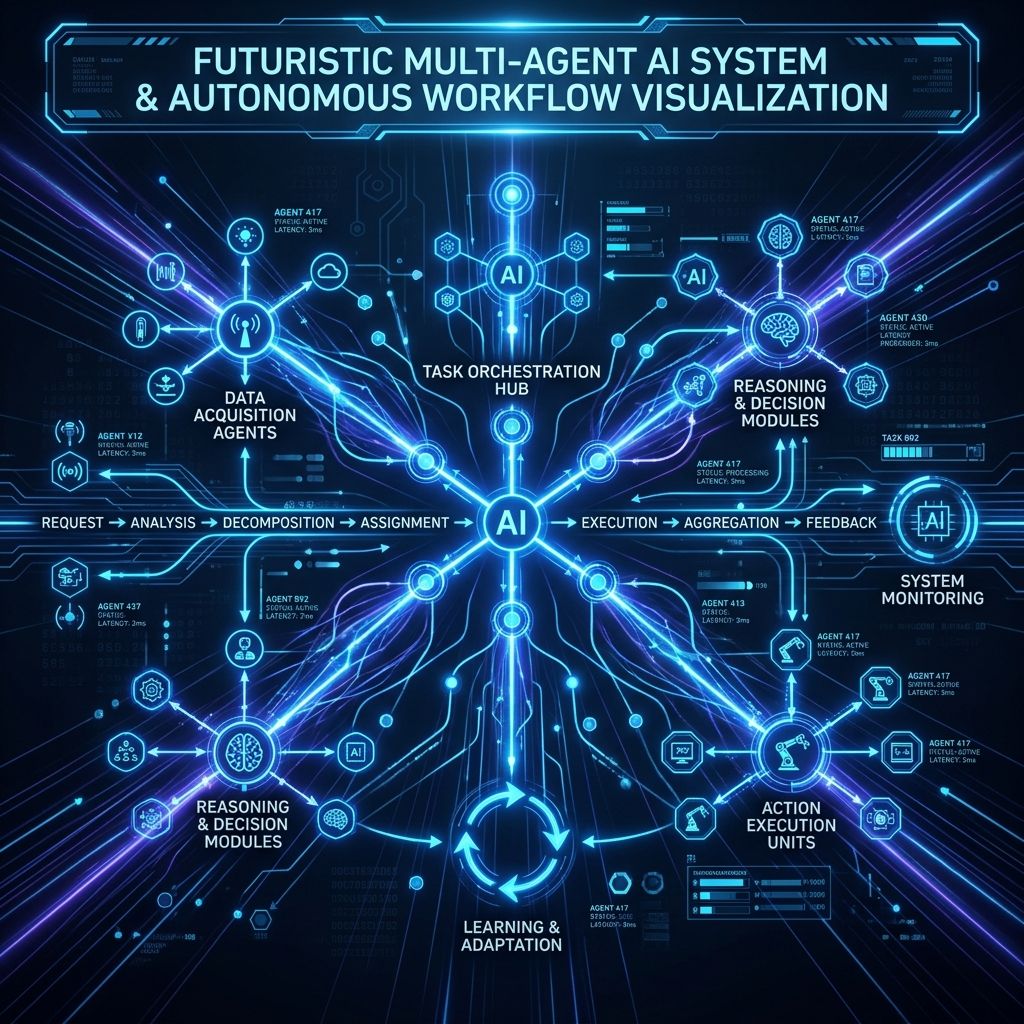
Introduction: From Chatbots to Autonomous Agentic Workflows
The commercial AI ecosystem has evolved rapidly from passive chat interfaces to autonomous, goal-directed agentic workflows. Modern AI agents do not merely generate text responses—they perceive environment states, inspect codebases, execute API tool calls, analyze error feedback, and recover deterministically from failures.
However, building enterprise-grade AI agents requires moving beyond naive prompt loops. Without strict architectural guardrails, autonomous agents frequently encounter infinite execution loops, hallucinatory state transitions, and runaway API expenditures.
The Four Pillars of Production Agent Architecture
A resilient agentic system relies on four decoupled functional layers:
Deterministic Tool Calling Protocols & JSON Schemas
Tool calling is the primary mechanism through which AI agents manipulate external systems. To prevent malformed arguments from breaking downstream execution, all tool interactions must be guarded by strict JSON Schema validation.
When an LLM produces a tool call payload that fails schema validation, the error payload is returned directly to the agent's context as a correction signal, enabling self-healing repair without crashing the orchestration loop.
Subagent Delegation & Multi-Tier Routing
Operating a single giant model for every agent action creates unsustainable latency and cost. Production architectures employ a multi-tier delegation model:
Execution Step Budgets & Loop Guardrails
To ensure autonomous agents remain reliable in production, developers must implement explicit safety boundaries:
Engineering Blueprint for Multi-Agent Orchestration
When designing multi-agent software pipelines, engineering teams should follow these implementation standards:
Inside GPT-5.6-Cyber: OpenAI’s Dedicated Defensive Frontier Model and the Daybreak Expansion
OpenAI has expanded Daybreak, introducing Daybreak Blue and Daybreak Red alongside GPT-5.6-Cyber—a specialized model achieving a 95.0% completion rate on advanced cybersecurity completion benchmarks. Here is the full technical analysis.
Inside Gemini 3.6 Flash: Google's Token-Efficient Workhorse for Scaling Agentic AI
Google has released Gemini 3.6 Flash, reducing output token consumption by 17% globally and up to 65% on DeepSWE while slashing inference costs. Here is the full breakdown for AI architects and tech leaders.
Explore technical definitions, architecture diagrams, and chronological market timelines referenced in this article:
Get top 5 high-signal AI news, venture funding rounds, and research papers auto-routed to dedicated channels every 3 hours.